From your manuals, a path that adapts to whoever walks it.
Whoever creates a training project uploads the documents. The system generates the path, calibrates the quizzes where needed, reformulates the explanations in the style that works for each learner. A single system serves three distinct audiences: companies training their own employees, professionals preparing for exams and certifications, students studying on their own materials.
Model
Multi-tenant SaaS
Content source
The client's manuals
AI engine
AYXZA Relay
§ 01What it is, and what it is not
Not a catalogue of courses. A tutor that builds the path from the material you give it.
The founding principle of AYXZA Tutor is simple: whoever creates a training project uploads the manuals, and the system does the rest. From the uploaded documents the artificial intelligence generates a proposal for a structured learning path, which the creator validates. End users walk the modules with explanations generated from the corpus, quizzes that focus where they get it wrong and reformulations calibrated on the approach that works for them. Companies get completion tracking and certificates; individuals get a personal tutor that knows them.
What it is
A platform where the path is born from your documents, not from third-party content
An engine that makes every path adaptive, sensitive to where each person struggles
A single system for corporate training, professional preparation and individual study
What it is not
Not a traditional LMS : no pre-packaged video courses, no content marketplace
Not an accredited training body: the certificates are internal, not regulated
Not a surveillance tool: the reporting shows completions, not individual mistakes
§ 02Three audiences, one system
Three different needs coexist in the same system. The content and the context change, not the engine. This is the platform's first economic advantage: a single engineering practice serves markets that normally require separate products.
01 · Companies
Internal training
Onboarding, internal procedures, compliance (for example safety or anti-money-laundering material as non-certified internal training), updates on one's own products and services. The company uploads its manuals and trains its employees on its real material.
02 · Professionals
Preparation and exams
Qualifying exams, technical certifications, public competitions. The professional uses a project from the official catalogue or uploads their own materials and builds a tailored path, with quizzes that insist where they are weakest.
03 · Students
Individual study
The student uploads their own notes and books and has the path built for them: explanations drawn from their material, assessments that return to wrongly-answered concepts, review cards written from their own books.
§ 03How it works, from start to finish
Seven phases, the same ones the project page shows one by one. The meaningful human work lies in validation.
The training project is the central entity. From uploading the documents to issuing the certificate, the path goes through a precise sequence. The system generates the learning proposal; approval always stays with a person.
01
Upload the manuals
PDF with text, Word, plain text or Markdown. The creator provides the reference corpus.
02
The AI proposes the syllabus
A map of the manual's themes, then modules and topics with references to the sections.
03
References validated
Every reference is searched for in the text; those not found block approval.
04
Human validation
The creator renames, reorders, merges, deletes, adds.
05
Approval
The approved syllabus becomes an immutable version.
06
Content
Explanations, questions and review cards, with a cost estimate before starting.
07
Assignment
Adaptive delivery, reporting and certificate on passing.
A guarantee constraint, not a detail: no project goes into delivery without human validation of the syllabus. The machine proposes, the person responsible for the content approves. It is the safeguard that holds together the promise of automation with training responsibility.
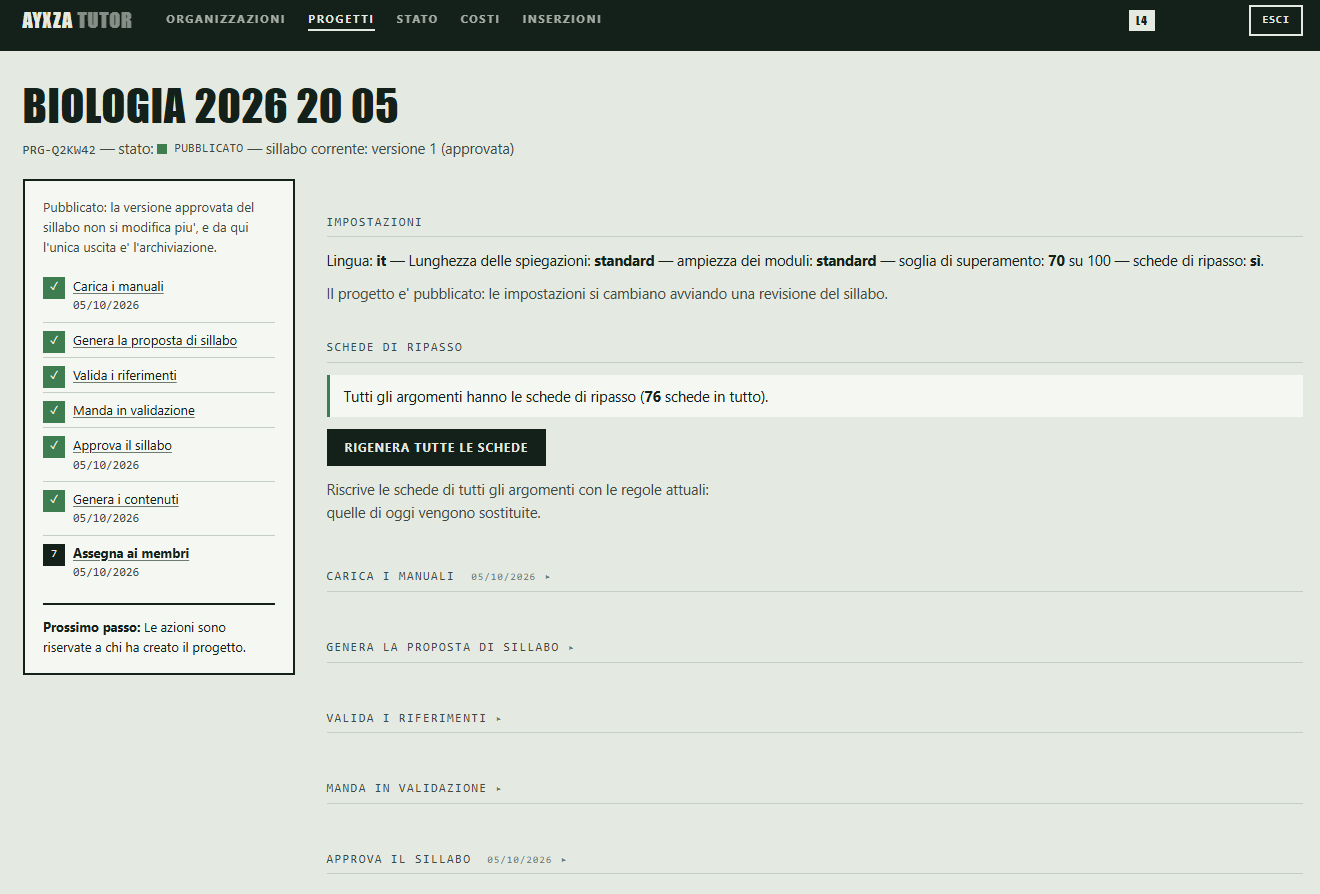
tutor.ayxza.comL4
The page of a published project, as AYXZA sees it: the seven phases with their dates, the course settings and the review cards already generated for every topic. The screenshot shows the Italian interface; the same pages are available in English.
§ 04The four levels
Who can do what depends on the level. Each level has a colour, and a clear perimeter.
The platform is organised on a four-level hierarchy. The colour identifies the role throughout the interface: slate for the superuser, indigo for the company, petrol for whoever takes the courses. An intermediate level, the reseller, exists in the data model without an interface of its own: every company is attached to it through a default reseller.
Hierarchy L4 → L3 (data only) → L2 → L1 · the scope is always derived from the session
Level
Who they are
What they can do
L4 · Superuser
AYXZA
Manages the entire platform: the companies, the catalogue of official projects and their enabling per company, the system status, AI costs and spending quotas, campaigns and sponsor boxes.
L3 · Reseller
Data model only
No interface. The level exists in the data model: every L2 is attached to a default reseller.
L2 · Company / Individual
Client company, or the single professional/student
Manages its own L1s (companies only), creates internal training projects, assigns to its members the catalogue projects AYXZA has enabled for the company, sees completion reporting, enables or disables personal creation for its users, uploads the logo shown on certificates.
L1 · End user
Employee, professional, student
Has their own login and a personal learning history. Walks the assigned projects and, if enabled, creates personal projects.
The single user: one account, the structure stays hidden.
A professional or a student registers on their own and lives the experience as an ordinary single account. Underneath, the system creates in a single operation an “individual” L2 and an L1 within it. The interface never shows employee management, group reporting or company permissions. This choice has a precise reason: a single path in the code for permissions, quotas and billing. Billing is always to the L2, whatever it is.
Individual registration · the user sees one account, the system keeps an L2 of themselves
§ 05The training project
Every project has an owner, a visibility perimeter and a lifecycle. The underlying rule is clear: only the creator modifies. A company does not touch another company's projects or those of the official catalogue; it uses them. A catalogue project enabled for a company stays AYXZA property: the company assigns it, does not modify it.
Creation
Who can create a project
Every enabled level: the superuser for the official catalogue, the company for its own internal paths, the end user for their own (if the company allows it; for individuals it is always allowed).
Manuals
Corpus upload
The creator uploads the source documents: PDF with text, Word, plain text or Markdown. Technical requirement: the files must contain extractable text. Image-scans are rejected on upload with a clear message and guidance on how to obtain a text document.
Settings
The course is tuned before it is generated
Language of syllabus, explanations and assessments (Italian, English, Spanish, French, German, Portuguese), whatever the language of the manuals, with proper names and technical terms left in the original; length of the explanations (standard, short, in-depth); breadth of the modules (standard, compact, broad); pass threshold; review cards yes or no. True/false questions and the certificate come out in the same language.
Syllabus
Structure proposed by the AI
Two passes: first a map of the manual's themes, then the structure in modules and topics, each with references to the sections it derives from.
References
Every reference is searched for in the text
Syllabus references not found in the manual block approval until the creator corrects them, deletes them or explicitly chooses to keep them. A topic added by hand is linked to a section of the manual.
Validation
Creator approval
The creator reviews the proposal: renames, reorders, merges, deletes, adds modules. Approval is explicit and mandatory, and the approved syllabus becomes an immutable version.
Content
Explanations, questions and cards
After approval the system writes the explanations, the assessment questions and the review cards. Before starting it shows the cost estimate, next to the real cost of the last run.
Update
Only the creator modifies
New manuals, syllabus revision, new version. A revision is approved when nobody is walking the course, and the topics that stayed the same keep the content already generated and the learners' choices.
Ownership and visibility
Created by
Visibility
Example
L4
Official catalogue: AYXZA enables it for individual companies, which assign it to their users
“State-exam preparation”, “Basic IT security”
L2 company
Only its own users
“Onboarding new hires”, “Internal quality procedures”
L1
Only themselves
The student uploads the university course notes
Personal creation by employees is governed by a permission, off by default in companies and always on for individuals. When it is on, an employee's personal projects live within the company perimeter but their content is not visible to the company: the company knows they exist and how much space they occupy, not what they contain. It is the principle of proportionality applied to data.
§ 06The learning engine: where the difference lies
A quiz that focuses where you get it wrong. An explanation that changes approach when the previous one did not work.
Study
Explanations from the corpus
The explanations are written from the passages of the manuals that the syllabus cites for each topic, in the length chosen by the course creator, and are navigable by topic. A second pass checks them against the same passages.
Assessment
Quizzes generated from the corpus
Multiple choice and true/false, generated from the manual and verified against the sources before being administered. The pass threshold is set by the course creator (seventy out of a hundred unless changed).
Completion
Progressive unlocking
Once the threshold is passed, the module is completed and the next one unlocks, with a recorded date. On completing all modules: final project outcome and, where provided, certificate.
Review
Review cards
Three to five short questions per topic, with a one- or two-sentence answer, written specifically from the manual and checked against the sources. You reveal the answer and mark “I knew it” or “To review”; the system shows first the cards of topics answered wrongly in assessments and those marked for review. They do not count towards the score.
Two forms of adaptivity
Adaptivity is not a label. It takes two concrete forms, both based on fine tracking of every answer, traced back to the syllabus concept it belongs to.
Every answer feeds the profile · the approach that leads to success guides future reformulations
Selection
The assessment insists where needed
Every topic answered wrongly returns in the next assessment with at most two unscored questions, until it is answered correctly, with at most two topics per assessment. The review does not depend on the days elapsed but on the errors still open.
Explanation
When one approach does not work, another is tried
With two or more errors on the same topic the alternative explanation arrives by itself, for at most two topics per submission; the learner can also ask for it, with a button, on any topic answered wrongly. The reformulation uses an alternative approach: practical example, formal definition, analogy, step-by-step procedure. It records which approach preceded success. The effective-style profile, learned per person, guides reformulations across all their projects. An explicit guard in the prompts prevents the reformulation from being a mere paraphrase: it must change the approach, not the words.
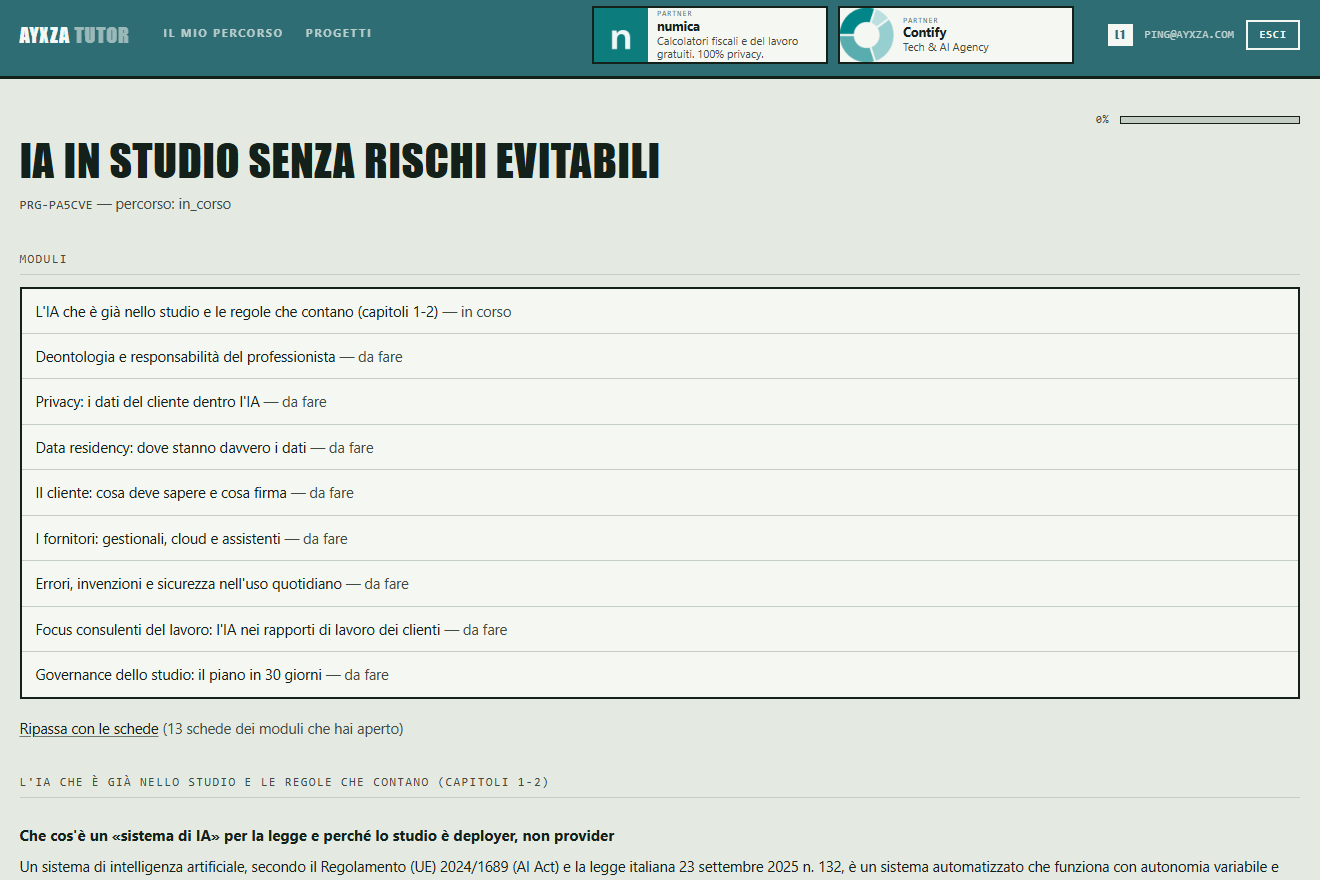
tutor.ayxza.comL1
The path as the learner sees it: the modules with their status, the link to the review cards and, below, the explanations of the current module. At the top, the sponsor boxes AYXZA assigns to the company.
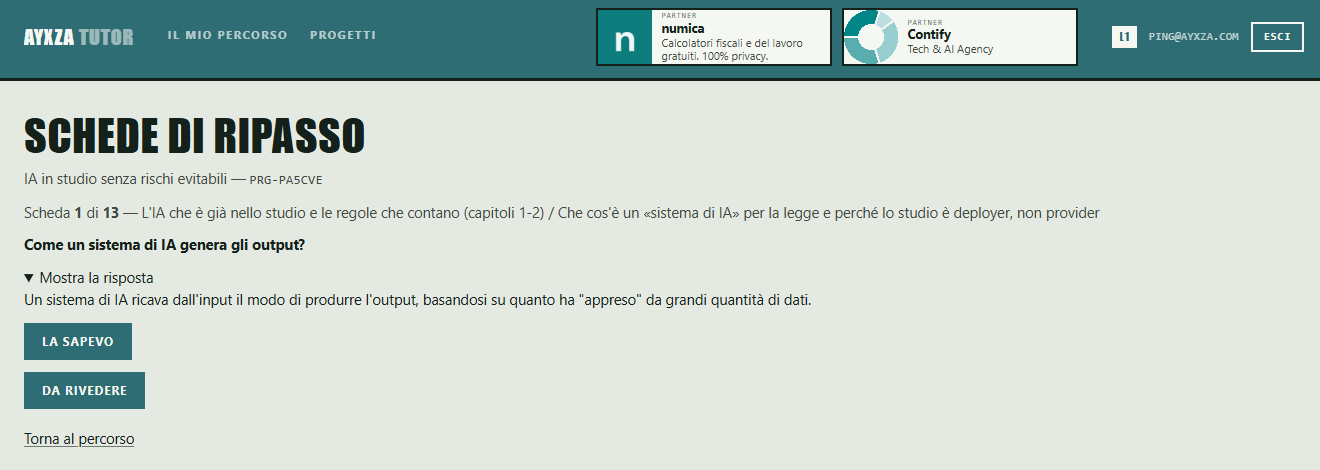
tutor.ayxza.comL1
A review card: you read the question, reveal the answer and mark whether you knew it. The choice stays with the learner.
§ 07Reporting and privacy, by construction
The company knows whether the path was completed. It does not know where the employee got it wrong.
The reporting is deliberately asymmetric, and this asymmetry is a guarantee offered to the end user, not a limit. The separation is enforced at the level of data querying, not just the interface: the individual learning datum is not reachable by the company by construction.
L2What the company sees
Status per person: not started, in progress, completed
Current module and percentage of progress
Final outcome with date, and downloadable certificate
At group level (minimum five users): distribution of outcomes, concepts the group as a whole struggles with, average times
L2What it does not see
The answers to individual quizzes
The specific errors and individual weak areas
The choices made on the review cards
The user's personal learning profile
The anonymisation threshold (five users minimum per aggregate) prevents the “group” datum from becoming a way to trace back to the single person. The signal the company obtains stays valuable: if a concept puts the whole group in difficulty, the material is often lacking or badly explained, and that is where it is worth intervening.
The certificates
On successful completion the system generates a PDF document with the person, the course, the date, the outcome, the company logo and a sixty-four-character verification code: anyone can check it on a public page, which confirms course, date and issuer without showing the name. It counts as internal evidence and corporate documentation. It is not a certification of regulated mandatory training: it does not replace the courses delivered by accredited bodies.
§ 08In service, level by level
In production at tutor.ayxza.com since 2 September 2026, with real sign-ups from a public campaign.
L1 Whoever takes a course
Study from any device
Tutor installs on the phone or the computer as an app, without going through a store; without a network it shows only a “You are offline” page and no data stays on the device. On every page three buttons enlarge the text. Whoever receives the company link signs up on their own with name and email, receives the temporary password by mail and may find the courses chosen by the company already assigned. The interface speaks Italian and English: each person picks a language from the profile, the company sets the default for its users and, when no choice has been made, the browser's language applies.
L2 The company
Management without intermediaries
The contact person uploads the company logo (PNG, JPEG or WebP), shown in the heading of the certificates. They see the per-person report and the group summary, with a threshold of five people for every aggregate number. Courses are assigned automatically to whoever signs up from the link. For every account: new temporary password, archiving and restoring, deletion for those with no history.
L4 AYXZA
Campaigns, costs, sponsor boxes
Campaigns with free courses: a container company, a public sign-up link with an anti-robot check that uses no external service, a daily cap on sign-ups, credential emails sent from a queue at a controlled pace, a privacy notice chosen per company. AI costs per use and per project, engine spending quotas per platform and per company checked before every generation. Up to two sponsor boxes per company in the top bar, with clicks counted without knowing who made them.
§ 09The benefits, for whom
For companies
Training on real material
Training is born from the company's real procedures, not from generic courses. Completion tracking and certificates ready for internal audit. Respect for the person: no surveillance of individual errors, an element that eases adoption and labour relations.
For professionals
A coach that knows you
Preparation focuses where one is weak and returns to wrongly-answered concepts until they stick. The explanations change form until one works. Study time goes where it is needed, not evenly spread over what one already knows.
For students
Study on your own books
The student uploads notes and texts and gets a structured path, with assessment and review. Explanations, questions and cards come only from what has been uploaded, and a second pass checks them against the same passages: no content extraneous to the course.
Cross-cutting · 01
Content-production cost almost zeroed
No instructional designer is needed to build the path: the system proposes it from the documents, and a person validates it. The human work shifts from writing to review, far faster.
Cross-cutting · 02
A single system for three markets
The same platform serves companies, professionals and students. No product fragmentation, a single system to maintain and evolve, economies of scale that reflect on the price.
§ 10A note of caution: limits and boundaries
An honest product declares what it does not do. The limits that follow are partly technical constraints, partly deliberate design choices. Knowing them beforehand avoids disappointed expectations.
To keep in mind
Documents
No optical recognition (OCR)
The manuals must contain extractable text. Image-scans are rejected on upload. A share of real corporate material is made of scanned documents: for those cases a text PDF must be obtained first.
Certificates
Internal, not regulated
They count as internal evidence, they do not replace certified mandatory training (for example that required by safety law) nor do they grant credits from professional bodies.
Reporting
Deliberately limited
Anyone expecting a control dashboard on the single employee will not find it: it is a choice, not a shortcoming. To a manager used to individual measurement it may seem a limit; for the organisation it is a protection.
Quality
The path is worth as much as the manuals
On disordered or incomplete material the syllabus proposal can be weak. Human validation is the safeguard for this, but it remains real review work: it is not “zero effort”.
Correctness
The risk of wrong quizzes is mitigated, not zeroed
Every question passes a verification against the sources before being administered. The residual risk exists, as in every generative system, and must be overseen by human review.
Processing
Data passes through model providers
The AI functions rely on external language-model providers, under the relevant processing agreements. For companies with stringent requirements the same platform runs on a dedicated instance (see the technical part). When the AI service does not answer, the page says so in a plain sentence for each cause; the technical detail stays in the system logs.
§ 11Security and compliance
Individual datum
Reserved to whoever generates it
Errors, requested explanations, choices on the cards and learning profile are accessible only to the person concerned, never to the company. The separation is enforced at the level of data querying.
Transport and credentials
Encryption and protected sessions
Traffic encrypted at the edge, secure cookies, protection against forged requests in restrictive mode, passwords stored with Argon2, a limit on sign-in and sign-up attempts.
GDPR
Clear roles, archiving and deletion
For employees the data controller is the company and AYXZA is the processor; for individuals AYXZA is the controller. An account with no history is deleted; the others are archived and restored, so the learning history is not lost through a management mistake.
Sensitive companies
Dedicated profile
For those who cannot accept that content transits a shared infrastructure, the platform installs on a dedicated instance: same code, a single client.
§ 12Technical part
A sober stack, a single AI engine, a data model designed to grow.
The architecture favours stability and reuse over novelty. It deliberately takes up the patterns of another AYXZA system already in service, so as to rest on tested skills and operational procedures instead of reinventing them.
Application stack
Area
Choice
Application
FastAPI with Jinja2 templates, server-side rendering, no single-page application. A light and robust interface.
Database
PostgreSQL, a dedicated database with separate schemas for the domain and the AI engine, migrations versioned with Alembic.
Authentication
Passwords stored with Argon2, session in a signed cookie holding no secrets, role re-read from the database on every request, password change on first access, limit on sign-in attempts, anti-forgery protection in restrictive mode.
AI engine
AYXZA Relay as an in-process dependency. All AI functions pass through the engine as versioned prompts; no direct calls to providers from the application.
Multi-tenancy
Logical isolation: the scope of every operation is derived from the server-side session, never from the payload sent by the client. The dedicated profile is the same codebase with a single client.
The AI pipeline on the engine
Every intelligent function is a versioned prompt on the engine, with a validated output schema where needed. The most commercially sensitive risk, a quiz with a wrong answer, is overseen by a double pass.
Function
How it is built
Syllabus generation
Two passes: a map of the manual's themes, then modules and topics with references to the sections, found automatically in the text. Output in structured, validated format.
Explanations
Written from the passages of the manual cited for that topic, in the language and length chosen for the course; a second prompt checks them against the same passages.
Quiz generation
Prompt with output schema (question, options, correct answer, concept, error explanation). Double pass: a critic prompt verifies every question against the sources before administration.
Review cards
A dedicated prompt writes three to five cards per topic from the cited passages; a second prompt verifies their correctness and drops duplicates across topics.
Explanation reformulation
Prompt with an approach parameter and per-user approach history, with an explicit guard against paraphrase.
How the components talk to each other
The application never talks directly to the providers: everything passes through the engine, which oversees prompts, costs and keys
The domain model, in brief
The data core records every answer with the concept, the type of error, the module, the instant and the explanation approach served. This granularity carries the assessment that insists where needed, the choice of the alternative explanation and the concept-level summary the company sees in aggregate form.
Entity
Role
progetto_formativo
The central entity: title, status, creator, course settings and current syllabus version.
sillabo_versione
Immutable snapshot of the approved syllabus, with reference to the original AI proposal for traceability.
avanzamento
Per person and project: current module, status, final outcome and completion date.
evento_apprendimento
The granular log of every learning interaction. It is the basis of adaptivity and of the concept-level summary.
profilo_didattico
Per person: the explanation approach that proved effective, and the style statistics.
attestato
The document generated on completion, with a unique verification code that can be checked on a public page.
scheda_ripasso
The cards of a topic, written from the manual and verified. The learner's choice lives in a separate table, which the company does not query.
Delivery model
The platform is offered as a multi-tenant service, with logical isolation of clients. For organisations with stringent confidentiality requirements the same codebase runs on a dedicated instance: a single client, no sharing of infrastructure with others. The choice between the two profiles does not change functionality, it changes the boundary on which the data lives. The service has been in operation at tutor.ayxza.com since 2 September 2026.