Products / Operational platforms PFM-04

Numica.

In service

Thirty-three Italian tax and payroll calculators, free, with the formulas in the open. The server does the arithmetic; the data stays with whoever typed it.

https://www.numica.it/ 2026 parameters
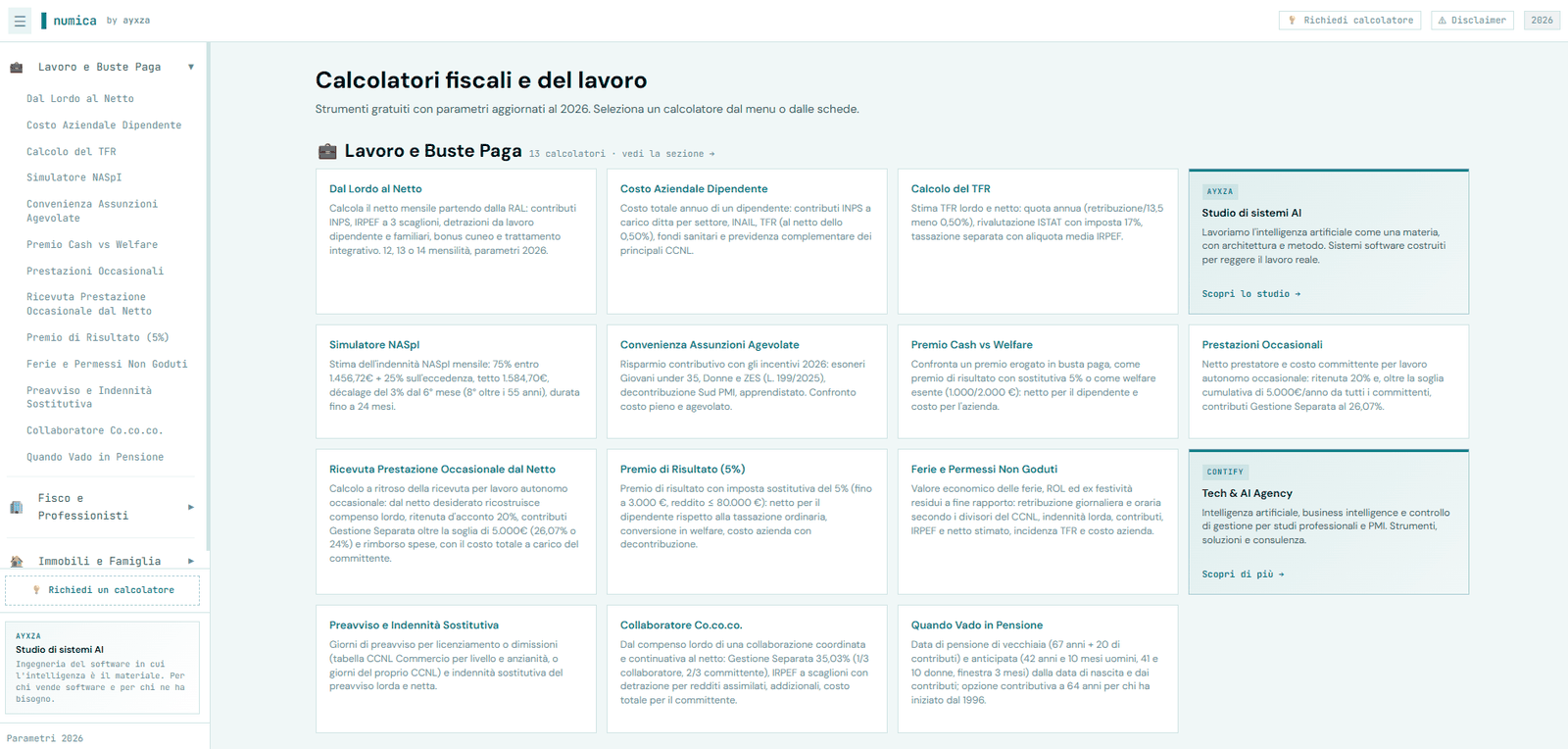
The Numica homepage: a side menu listing the calculator categories and a grid of cards for payroll and employment tools.
The public index. Every card leads to a self-contained, server-rendered page holding the form, the calculation, the formulas, the legal sources and a worked example. The site itself is in Italian, because Italian tax law is what it computes.
§ 00 Abstract free product · in service since 2026

Numica is a calculation site for Italian accountants, payroll advisers and for anyone who has to answer, quickly, a question with a number inside it: what is left in a payslip once you start from the gross annual salary, what an employee really costs the company, what a late tax payment costs once the reduced penalty and the statutory interest are added, whether the flat-rate regime beats the ordinary one. It is not a management system, it asks for no account, it keeps no files.

What sets it apart is a matter of method rather than of function. A tax calculator receives data that describe a person: their income, their children, their home. Numica is built so that those data leave no trace. No third-party service loads into the page, no profiling cookie, no log of the inputs. The request comes in, the answer goes out, and nothing is written in between. The rest follows the same rule: every calculator shows its own formulas, the legal sources and the parameters for the year, and every parameter declares the circular or the decree it comes from.

Why it sits in this catalogue. Numica contains no artificial intelligence, and does not pretend otherwise: it is statutory arithmetic, verified case by case. It belongs here because it shows the part of the craft that stays the same when the material changes, the discipline that also holds up the systems where a model really does decide: parameters in one place, formulas in the open, results put to the test before every release, and a data practice that can be described in full on a single page.
§ 01 Privacy no third party · no input stored

Tax data are personal data. The rule is that the calculation does not keep them.

01No third party in the page

A browser opening a Numica page talks to exactly one domain: Numica’s own. The typefaces are hosted on the same server rather than fetched from an external CDN; there are no third-party analytics scripts, no tracking pixels, no maps, no social widgets. An ad blocker finds nothing to block.

That is why the site has no cookie banner: not because it has been hidden, but because there is no tracking to consent to. The only cookie in circulation is the technical session cookie of the admin area, which an ordinary visitor never meets.

02The calculation leaves no trace

Every calculation is a request to the server, which takes the submitted values, runs the calculator’s function and returns the result. The controller that receives it writes the inputs neither to a database nor to a log file: income, rent, means-test index, the children’s ages, the sale price of a property go in, produce an answer, and are not kept.

What the site does record is that a calculation happened on that calculator, without its values. It is the only measurement needed to know which tools are being used and which are not.

03Measuring use without measuring people

The analytics are written in house and hosted on the same server: they count pages opened, calculators opened, calculations run and where the visits came from. The IP address is anonymised before it is written, by truncating the last octet, and it is never used to build profiles or to recognise a visitor across two sessions.

The detailed visit log deletes itself after ninety days. Only the daily aggregates survive: one number per day, per event type, per calculator. They hold no personal data and serve to understand, month after month, which tools have an audience.

04What the visitor chooses to leave

Two features collect information on an explicit request: the star rating with an optional comment after a calculation, and the form for asking for a new calculator, which needs an email address in order to reply. Both cap how much a single address can send, and both keep the data for one year, after which the system deletes it on its own.

The privacy notice under article 13 of the GDPR is published on the site and describes exactly this perimeter. There is no long version and short version: there is one page, because the processing is small enough to fit in one.

§ 02 How it is built one page per calculation · one function per calculator · one file for the parameters

A calculator is a pure function, a page that explains it and a test that checks it.

01One page per calculation

Numica is not a single-page application. Every calculator lives at its own readable address, of the form /calcolatori/lordo-netto, and the page is assembled by the server with all its content already in place: title, form, explanation, formulas, legal sources, frequent questions, a worked example. A search engine, or a conversational assistant that cites its sources, reads the whole page without running JavaScript.

The calculators are grouped into three categories, each with its own index page. The home page is an index of links, not a container of state.

02The engine: one function, one contract

Every calculator is a single PHP file exposing one function: it takes the form fields and returns a table of results. The register of calculators is a configuration file listing, for each one, the identifier, the engine file and the form fields with label, type and whether they are required. From that register the site generates the form, the page and the list of permitted calculations.

The controller accepts only identifiers present in the register and loads the corresponding file from that list, never from a value received from outside. Adding a calculator means writing an engine, a register entry and a content entry: three files, with nothing else touched.

03Parameters with a source, in one place

Income tax brackets, deductions, contribution rates, ceilings, statutory interest rates by year, child benefit amounts, depreciation coefficients, hiring incentives: everything that changes with the budget law or with a circular sits in a single parameter file, where each block states the rule or the act it comes from. The engines hold no hand-written numbers, they read them from there.

The annual update is therefore a contained operation: change the parameter file, let the test suite show which results moved, check them one by one, regenerate the examples in the pages. The formulas shown to the reader and the ones the server executes are the same, by construction.

04Checked before it is published

Every calculator has at least one test case with inputs and expected results worked out by hand from the sources, fifty-four cases in all, covering the error paths and the Italian number formats with a decimal comma and a thousands dot. The suite runs before every release and again on the server afterwards: a release with one red case does not go live.

The simplifications are declared at the head of every engine and on the page that accompanies it. A general calculator cannot stand in for a specific national labour contract or a municipal surcharge, and it says so before anyone relies on it.

§ 03 Numbers as of September 2026
33
Calculators in service,
in three categories
0
Third-party domains
contacted by the browser
54
Test cases whose expected results
were worked out by hand
90d
Maximum retention of the detailed
visit log, anonymised
§ 04 Components PHP on shared hosting · no framework
§ 05 Register of calculators 33 tools · 2026 parameters
01 Payroll and employment Thirteen calculators: from the employment relationship to freelance collaborations, all the way to retirement requirements. Category index ↗
  1. 01·01Gross to net payMonthly net pay from the gross annual salary, with contributions, three income tax bands, deductions and payroll bonuses.
  2. 01·02Total cost of an employeeFull annual cost to the company: employer contributions by sector, accident insurance, severance accrual, health and pension funds.
  3. 01·03Severance accrual (TFR)Annual accrual, inflation revaluation with its own tax, and separate taxation at the average rate.
  4. 01·04Unemployment benefit (NASpI)Monthly amount, the taper from the sixth month and a duration of up to twenty-four months.
  5. 01·05Subsidised hiringContribution savings under the 2026 incentives: young workers, women, southern regions, apprenticeships.
  6. 01·06Cash bonus vs welfareCash in the payslip, productivity bonus with substitute tax, or exempt welfare: net to the employee and cost to the company.
  7. 01·07Occasional self-employmentNet to the provider and cost to the client, with withholding tax and the cumulative contribution threshold.
  8. 01·08Occasional invoice from the netWorked backwards: from the agreed net to the gross on the receipt, with withholding, contributions and expense refunds.
  9. 01·09Productivity bonus (5%)Substitute tax on the bonus, compared with ordinary taxation, and conversion into welfare benefits.
  10. 01·10Untaken leave and time offThe value of leave and time off left at the end of the contract, its effect on severance and the cost to the company.
  11. 01·11Notice period and payment in lieuDays of notice by grade and seniority, and the gross and net payment in lieu.
  12. 01·12Coordinated collaborationFrom gross fee to net: social contributions split between collaborator and client, income tax and surcharges.
  13. 01·13Retirement dateWhen old-age and early retirement become available under current requirements, including the deferral window.
02 Tax and professionals Fourteen calculators: taxes, penalties, regimes and break-even choices for self-employed professionals and companies. Category index ↗
  1. 02·01Voluntary correction of a late paymentReduced penalty and statutory interest by year, under both regimes before and after September 2024.
  2. 02·02Invoice worked back from the netFrom the net you want to the invoice total: pension surcharge, withholding tax, VAT and grand total.
  3. 02·03Late payment interestCommercial transactions, with the central bank rate plus the statutory margin, per half-year.
  4. 02·04Taxation of company profitsCorporate tax, regional tax and dividend tax: how much of a gross profit actually reaches the shareholder.
  5. 02·05Company carDeductible share of the cost and recoverable VAT according to how the car is used, with the statutory caps.
  6. 02·06Flat rental tax vs income taxFlat-rate rental taxation against ordinary taxation of a rent, registration tax and stamp duty included.
  7. 02·07Flat-rate regimeFrom turnover to net: the profitability coefficient by sector, social contributions and substitute tax.
  8. 02·08Flat-rate vs ordinary regimeNet income compared across the two regimes at equal revenue and costs.
  9. 02·09Contributions for traders and artisansFixed contributions on the minimum band in four instalments, plus the share due on income above it.
  10. 02·10Tax advancesAmounts and deadlines under the historical method, exemption thresholds, one instalment or two.
  11. 02·11Instalment plansInstalments with interest for taxes due on a return and for formal payment notices.
  12. 02·12Asset depreciationA depreciation schedule using the ministerial coefficients for each class of asset.
  13. 02·13Car: buy, lease or rentThe net after-tax cost of the three arrangements for the same company car.
  14. 02·14Vehicle tax and luxury surchargeRoad tax from engine power and emission class, with the surcharge above the power threshold.
03 Property and family Six calculators: rentals, sales, property taxes and support for children. Category index ↗
  1. 03·01Capital gain on propertyA sale within five years of purchase: substitute tax against ordinary taxation.
  2. 03·02Inflation adjustment of rentUpdating the rent from the official consumer price index, for free and regulated contracts.
  3. 03·03Universal child benefitMonthly and annual amount from the means-test index, number and age of children, with the supplements.
  4. 03·04Registration tax on leasesRegistration tax and stamp duty for a lease, per year or for the whole term.
  5. 03·05Short-term letsFlat-rate tax on short lets, with a different rate from the second property and the platform’s withholding.
  6. 03·06Municipal property taxTax from the cadastral income, category, municipal rate, ownership share and months held.

What it does not do. The calculators give fast, transparent estimates, not a tax return and not a payslip. The real figure depends on the national labour contract that applies, on municipal surcharges, on local resolutions for property and tourist taxes, and on situations with several income sources, carried-forward losses, tax credits or special regimes. Every page states the simplifications it has made.

A tax calculation is a personal question. The right answer is the one that does not need to remember who asked it.
project notes · Numica · September 2026

Let’s talk about a real problem.

ping@ayxza.com ↗